
What Is Memory Development?
A set of specialized exercises to improve various types of memory
- Short-term memory training
- Long-term memory development
- Improved attention concentration
- Cognitive function development
Training various types of memory and attention concentration
Scientifically proven methods for improving cognitive functions in children and adults
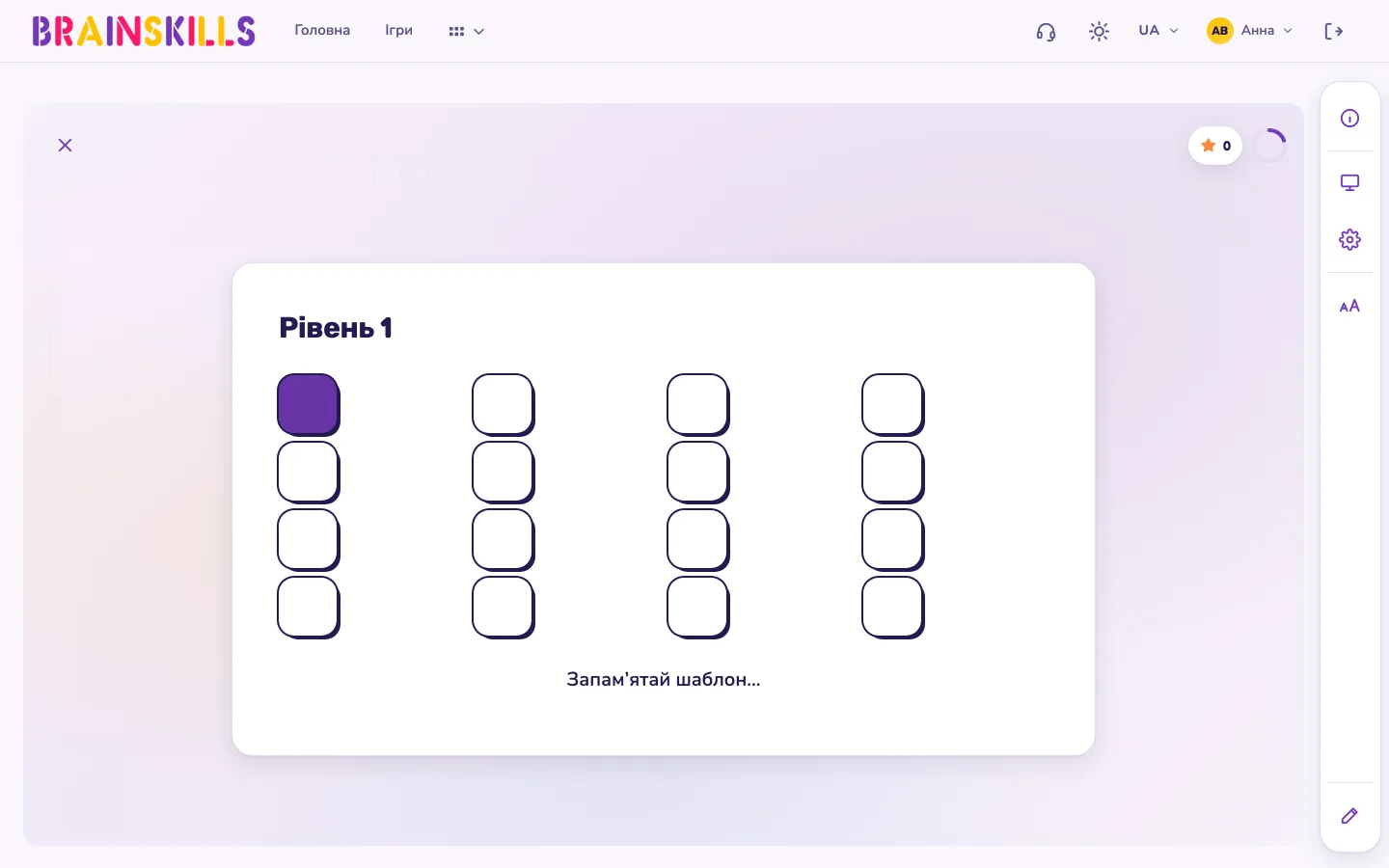
A set of specialized exercises to improve various types of memory
Interactive exercises and game-based techniques for all memory types
Three pillars
Comprehensive training of all memory types for maximum effect
Retaining information for short periods
Storing information for extended periods
Ability to focus
Platform modules
Specialized trainers for developing all aspects of memory
Memorizing card locations and matching pairs
This is not the full list — the Brainskills portal has many more trainers and games.See all trainers
What it gives you
Comprehensive positive impact on all areas of life
Exercises for short-term, long-term and visual memory.
Enhanced ability to focus
Faster information processing
Improved learning outcomes
Competitive advantages at work
Stable results for years
Any age
Effective programs for all age groups
School preparation
Improved academic performance
Professional development
Preserving cognitive functions
Daily practice
A ready daily block — where most students start
Memory and attention respond to regularity rather than volume: ten minutes every day beats two hours once a week. Here is a block you can run with a child at home or assign as homework from the teacher dashboard.
| Block | Time | What to do |
|---|---|---|
| Attention warm-up | 2-3 min | A Schulte table: gaze in the centre, numbers found with peripheral vision. Children start at 5×5, then 6×6 and 7×7. |
| Visual memory | 3 min | Flash cards or sequence recall: look for 5 seconds, reproduce from memory. Add one item to the sequence each week. |
| Auditory memory | 2-3 min | An adult dictates 6-8 words or numbers and the child repeats them. Next level: repeat them in reverse order. |
| Transfer to real life | 1-2 min | Recall out loud the plan for the day, a textbook page, or the route to school. This step is what makes the training useful outside the app. |
First changes usually show after 3-4 weeks: the child asks for the task to be repeated less often and stays with one exercise longer. If ten minutes a day is too much, five without gaps beats ten with them.
Exercise Example: Schulte Table
Find numbers from 1 to 25 in the correct order
This exercise trains visual memory, attention, and perception speed
Answers
Answers to the most popular questions about memory development
First improvements are noticeable within 2-3 weeks of regular training
Yes! Programs are adapted for preschoolers, students, adults, and seniors
We recommend 15-30 minutes of daily training for consistent results
Only positive ones! Memory improvement positively affects all areas of life
Ready to Develop Your Memory?
Start training your memory and attention today